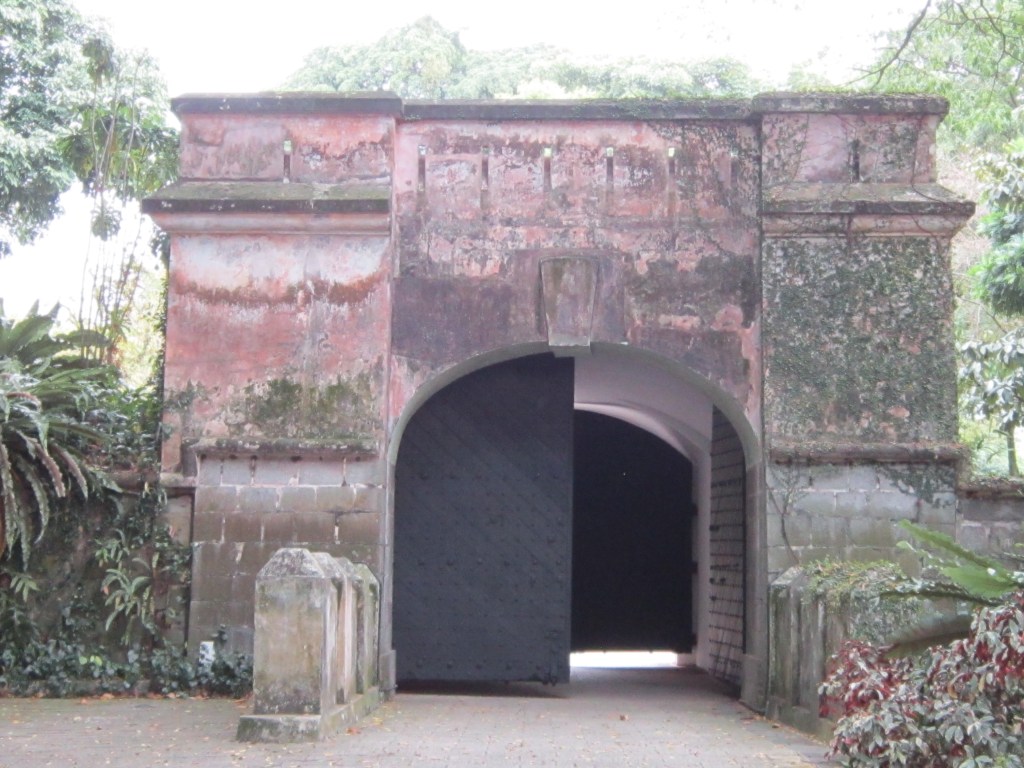
Just behind the National Museum of Singapore on Stamford Road lies a quiet green oasis that once was called the Forbidden Hill. Forbidden, because this was the hillside abode of the Malay sultans who ruled Singapore since the 14th century. It’s now Fort Canning Park and my good friend and knowledgeable guide Shobana took us for a walk in this scenic and historic spot.
As we strolled we came upon a plaque that awakened memories of old history lessons in school. An important treaty was signed on this site in 1824. To quote: “In 1819, the British were given permission to establish a trading station on the southern coast of Singapore. In theory the rest of the island still belonged to Tengku Long, whom the British recognized as the Sultan of Singapore. In 1824, the British resolved their disputes over territory with the Dutch and Singapore was recognized as belonging to the British sphere of influence. The British then convinced the Sultan to cede the rest of the island to them.”
The Englishman credited with the founding of modern Singapore in 1819 – Sir Stamford Raffles also chose this hill to build a small home for himself. We saw his house on the hill or rather a renovated version of it and, paused to admire the commanding view of the harbor. What we saw was probably something he might not have envisioned – a skyline dominated by towering buildings and mechanical cranes.
In his letters home, Raffles wrote that he could not imagine a better view than the one from his hilltop home. He also expressed a wish to be buried on the grounds with all the Malay sultans already interned there. That was not to be. Raffles died in England in 1826 at the age of 45 but not before establishing the Zoological Society of London and the London Zoo. He had a passionate interest in natural history and collected many specimens of flora and fauna during his time in Southeast Asia.
Ironically, Raffles only spent less than a year in Singapore but made important contributions including establishing the island as a Free Port; instituting law and order; devising an urban plan for the city that included separate areas for the different ethnic groups and providing facilities like roads and government buildings. He also established an institute of learning at Bras Basah Road. Raffles himself laid the foundation stone for the building which was completed in 1837 and later became known as Raffles Institution. I attended this college during my pre university years and met many good friends including Shobana there. So our friendship dates back over 40 years!
In our old history lessons mention was also made of Major General William Farquhar, the first British Resident and Commandant of Singapore. There’s some debate whether this Scotsman who helped Raffles to find a settlement on Singapore, to negotiate treaties and more importantly guided Singapore’s development in the early years [in Raffles’ absence], got the credit he deserved. Raffles fired him for adopting practices and measures that conflicted with his instructions. Farquhar later sued Raffles for tyrannical behavior. Historical sources cite the love and esteem that the local population had for Farquhar who was given a fond and elaborate farewell when he set sail for home. On his grave in Scotland is an inscription that credits him with the founding of Singapore.
It’s interesting that there’s a new history syllabus for secondary schools this year covering more of the pre-colonial era. Singapore we now know was already on the map in the thriving Malay Archipelago before colonization.
The towering Madras Thorn, Rain and Kapok trees in Fort Canning must be hundreds of years old! They should be considered a national treasure in a land-scarce island where there’s constant building and renovation and change to satisfy the over five million people who live and work here.
Once there were barracks for soldiers, a hospital and fortifications including 68 pound guns, mortars and smaller cannons on this hill. All that’s left of the fort that the English built between 1859 and 1861 is a gate and its adjacent wall and memories.


 Naseem's Blog
Leave a comment