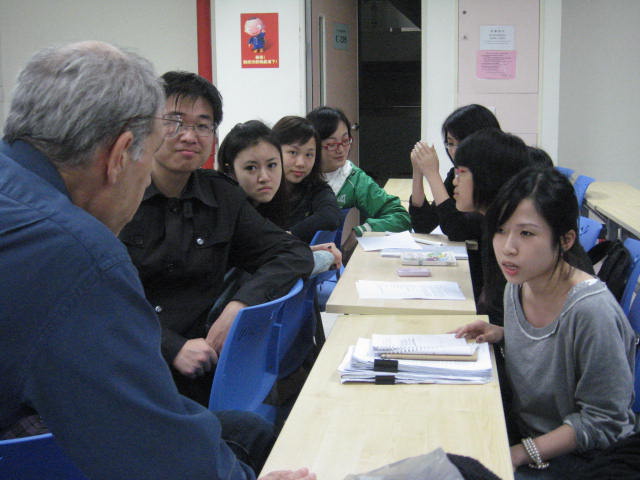
We actually celebrated our 28th wedding anniversary by presenting a joint lecture to university students in Zhuhai –a coastal city about an hour from Hong Kong by ferry. This was our first trip to mainland China and it was only for one day, as part of the Fulbright Lecture Series on American Identities. Our topic was the immigrant experience. We were picked up by a driver in Zhuhai who took us to International World College, a small liberal arts university that offers opportunities for a more rounded education to Chinese students. The faculty is very diverse, coming from all over the world. Fulbright professors come once a week to present a two hour talk followed by a tutorial that is moderated by a teaching assistant.
I was roped in to talk about my personal experience of moving to the United States after my marriage in Singapore and how I adapted to life in the American mid west. I’ll share some of what I told the students –about 50 of them. Here’s my story: that in spite of all my advantages – a loving husband and in-laws, a university education, language fluency and familiarity with American culture through media sources, I had a hard time adjusting to my new country. I longed deeply for what I had lost – my immediate family, close friends, the easy camaraderie etc. In retrospect, for me it was a kind of grieving process complicated by trips home, which only showed me how I did not belong there either, because of the many changes that had taken place during my absence. Two important turning points were: my children and deciding to get a masters degree in broadcasting and cinematic arts at Central Michigan University. My girls involved me with the community through their friendships, school and interests. I made many good new friends this way. The U.S. college experience opened up new doors for me. While in the past, I’d frequently been told by employers that they were looking for people with local experience, they could not say that to me now that I had local accreditation. It did not seem to matter to them that I had held senior positions at Singapore Broadcasting and had been trained by the British Broadcasting Corporation, the premier news organization at that time. A new career in print journalism in the mid 80s involved me in the mainstream and gave me the connection that had been lacking. As I wrote peoples’ stories, I also learned from them and became one of them. Their fears, sorrows, joys and concerns also became mine. I also spoke about my job at the State Bar, which promotes the legal profession and the rule of law – the very foundation of American society.
Bob’s presentation centered on art and literature and why it is such a central part of culture. He illustrated this with stories focusing on the immigration experience written by Asian writers such as Jhumpa Lahiri, Gish Jen, Marilyn Chin, and Khatar Dhillon. Literature and other art forms offer alternative ways to become acquainted with something by experiencing it – in the imagination. In getting us to vividly imagine lives and the issues, problems, and moral dilemmas that occur within them, we can see how things look from new points of view. We not only become intellectually aware of these but emotionally involved in them. They are brought home to us. The alien becomes familiar.
This is the first time Bob and I have had a collaboration of this nature and a working anniversary, but it turned out to be more rewarding than simply indulging in a fancy dinner.

 Naseem's Blog
Leave a reply to Melanie Jaramill Cancel reply